Our AI Advantage
AI isn't replacing engineering, it's redefining it. From robotics and manufacturing to design and systems optimization, today's engineers need to understand how AI works and how to use it effectively and responsibly.
Our AI advantage lies in how we create the frontier of AI technology and how we teach it. We go beyond tools and trends to help students master the fundamentals that drive intelligent systems, and then empower them to apply those principles to design, build, and innovate.
Pioneers in AI engineering
Long before "generative AI" took the world by storm, our department was already teaching engineers how to think with data, reason with algorithms, and build intelligent systems. In 1990, we led the world by offering a course on AI in Design.
Shaping the future of AI education
Today, we offer ten AI and ML-focused courses for graduate students spanning every layer of the technology:
Generative AI for Engineers
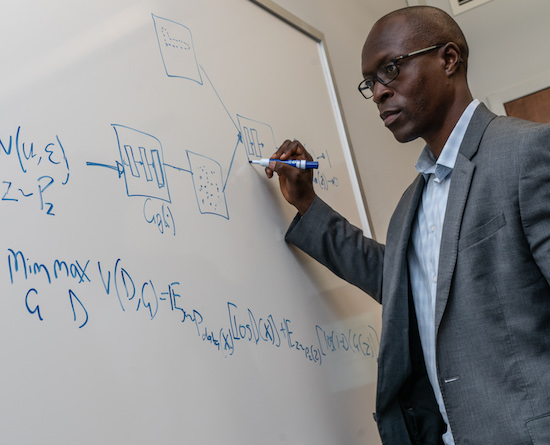
Beyond using generative AI, students create and customize state-of-the-art generative models capable of solving complex engineering problems.MS in AI Engineering
All of our graduate students are able to take our AI courses, but Carnegie Mellon is home to the world’s first Master of Science in AI Engineering. This program was designed specifically for engineers who want to bridge the gap between mechanical systems and intelligent technologies. It allows students to deepen their AI skills within engineering constraints and propel their careers.
Online graduate-level certificate
An online program for engineers who want cutting-edge skills in AI, ML, and deep learning.Taught by world-renowned faculty, these courses combine academic rigor with immediate real-world relevance, making them ideal for both full-time students and working professionals. Graduate students can begin with the online certificate, where four courses apply toward, and bring you halfway to completion of, our MS in MechE.
AI Fellows
The AI Fellows Program gives master's students the chance to work directly with faculty to bring AI tools into the classroom. Fellows develop intelligent systems to enhance education like automated tutoring assistants to improve real-time feedback. Students learn to use AI to support, not replace, the human creativity that defines great engineering.